


"TCC" total energy electrostatic powder charging technology


The core of all powder spraying equipment lies in the spray gun and the charging system. In terms of the charging system, both friction charging and corona charging have their own advantages and disadvantages. Friction gun charging is achieved by the electric charge generated when different substances rub against each other.
Corona charging is the charging method adopted in electrostatic spraying applications. It involves using a discharge needle tip to make particles pass through an ionized air area and become charged. This process is also known as corona charging. Due to the collision of ions in unipolar ionic Spaces, the charge q of spherical particles can generally be calculated according to Puthenier's formula, which
the formula is as follows :

It can be seen from the formula that factors such as the intensity of the charged electric field and the ion current of the corona discharge determine the level of the particle's charge.
There is a high-pressure needle electrode at the nozzle of the corona spray gun. During operation, a voltage as high as 100KV is generated on the electrodes, thereby achieving corona discharge.
A high-voltage electric field will cause the air near the electrodes to ionize and thus emit ions. Under normal circumstances, the negative ions in it will move towards the nearest object or surface. Therefore, when the powder particles pass through this area, they will be negatively charged and adsorbed by the grounded workpiece.
The greatest advantage of using high-voltage corona discharge to charge powder is that it can spray all types of thermosetting powder coatings available today and achieve excellent results. Therefore, this type of spray gun accounts for a very large proportion.
The main drawback of this system is that only a relatively small portion of the ions generated by the high pressure of the spray gun are adsorbed onto the powder particles, leaving many free ions.
These free ions and charged powders adsorb and accumulate on the surface of the workpiece together, which will lead to a well-known "reverse ionization" problem, causing the coating to discharge like a high-voltage needle.
This phenomenon can usually be observed very clearly, at which point the coating will no longer powder. In some cases, the surface of the coating may have protrusions, which can lead to the "orange peel" effect and even penetrate the coating, forming pinholes and shrinkage cavities.
When there are deep holes or depressions on the workpiece, since the electric field lines emitted by the discharge needle of the spray gun only point to the edge of the workpiece closest to it, the charged powder only adheres to the outer edge of the deep holes or depressions, and only the uncharged powder can enter the deep holes or depressions.
This is what everyone knows as the "Faraday Effect". When the voltage is higher, the electric field lines become stronger and the Faraday effect more severe. If the method of increasing the air flow velocity is adopted to force the charged powder into the concave holes, the surface coating may be blown away again.
Although the traditional corona discharge method for charging powder has the above-mentioned disadvantages, it is still the best method for powder spraying. That is to say, although electrostatic spray guns have problems such as Faraday effect, reverse ionization, orange peel and excessive charging, their advantages in terms of excellent stability, powder application efficiency and fast powder application speed far exceed those of friction spray guns. Although the latter can also be achieved, its performance is unstable.
Most manufacturers and users of electrostatic powder coating equipment believe that the most important factor in powder charging is electrostatic voltage.
However, from the perspective of those free ions that charge the powder, what really works is the current, not the electrostatic field or voltage. However, almost all suppliers of spraying equipment only design voltage control, allowing operators to control the discharge voltage.
If this method is adopted, when the spray gun approaches the workpiece, the discharge quantity will increase exponentially. This will generate excessive static electricity and free ions, leading to the problems mentioned earlier.
We are convinced that to achieve the best charging effect, it is necessary to adopt the method of controlling the discharge current. Our first-generation total energy spray gun was designed with the method of controlling the discharge current, with the current range being 0 to 50 μ A.
In this system, the operator only determines one current value and allows for fluctuations in the discharge voltage. In this way, when the spray gun approaches the workpiece, the output voltage will automatically decrease. This approach can effectively maintain the uniformity of charge, overcome the Faraday effect, reduce reverse ionization and minimize orange peel.
Due to the significant advantages of controlling the discharge current, it represents a breakthrough in electrostatic technology. However, we realize that although controlling the current has many advantages, it is still not perfect, mainly because the voltage value is a variable. When the spray gun is moved away from the workpiece, the current may be lower than the constant or set value, while the voltage may rise to the maximum, reaching above 80KV.
In some cases, this voltage may appear too high and generate overly strong electric field lines, which can lead to the Faraday effect. When the gun approaches the workpiece, it is obvious that the range of "ionizable air" between the two will gradually decrease. In terms of free ions, the number of air molecules that can be charged is relatively reduced. One point that must be kept in mind here is that it is the free ions that first charge the air molecules and then transfer the charge to the powder particles.
The above situation indicates that when the spray gun approaches the workpiece, due to the shortened distance between the discharge needle and the workpiece, both the discharge current and discharge voltage should be reduced.
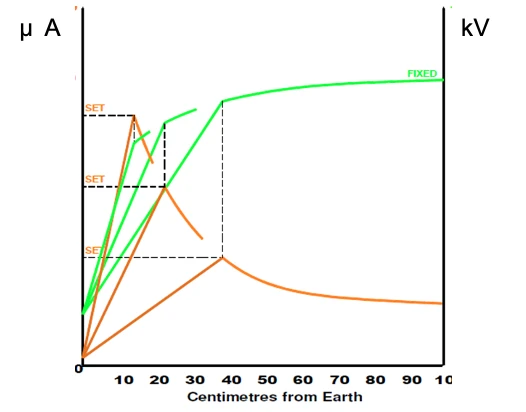
Since the first generation of total energy technology, we have been researching this electrostatic charge technology for over 30 years and have now developed the third generation of "TCC total energy charge Control" technology. The method mentioned above is precisely adopted in the third-generation "total energy control" technology. When the spray gun approaches the workpiece, the "total energy control" not only gradually reduces the discharge voltage but also synchronously decreases the discharge current.
The maximum value of the discharge current is still limited to 50uA, and the adjustment method remains unchanged. However, when the spray gun approaches the workpiece, both the discharge current and the discharge voltage decrease. In addition, the operator can also set the maximum voltage, which itself can control the magnitude of the discharge current.
The high-speed numerical control processor of our controller can sense the change in distance between the spray gun and the workpiece and automatically adjust the total energy of the corona discharge, rather than just regulating the voltage or current.
This is a very ideal way of working. Because when the spray gun approaches the workpiece, the amount of air that can be charged gradually decreases. By reducing the discharge voltage and current, the total energy also gradually decreases, thus achieving the best charging effect without causing excessive charging of the surrounding air or the surface of the workpiece.
When the total energy control technology is used, the electric field lines of the electrostatic field also weaken accordingly, which can more easily overcome the Faraday effect and enable the powder paint to have better permeability. In fact, the spray gun can be very close to the workpiece, almost touching the surface of the workpiece to carry out the charging process that matches its energy.
In this case, the general estimate is that the powder cannot be charged and will be blown away from the surface of the workpiece. But in fact, when almost non-charged powder is sprayed onto the surface of the workpiece, it can penetrate into the corners or recesses, and a very smooth and flat coating can be obtained.
Under normal circumstances, re-spraying a surface that has already been sprayed is a troublesome thing. Because the existing coating will insulate the static charges in the ionized air from the surface of the workpiece like a capacitor. Ionized air will reach the workpiece before charged powder. Due to their same polarity, the former will repel the latter.
Usually, at this time, to solve this problem, the operator will adopt the methods of reducing the discharge voltage and increasing the spraying distance, which reduces the speed of the powder and the amount of charge it carries.
When using a total energy control system, this is not necessary. When the spray gun approaches the workpiece, the charge will automatically decrease, thus preventing excessive charging or severe reverse ionization. Therefore, it is easier to repowder.
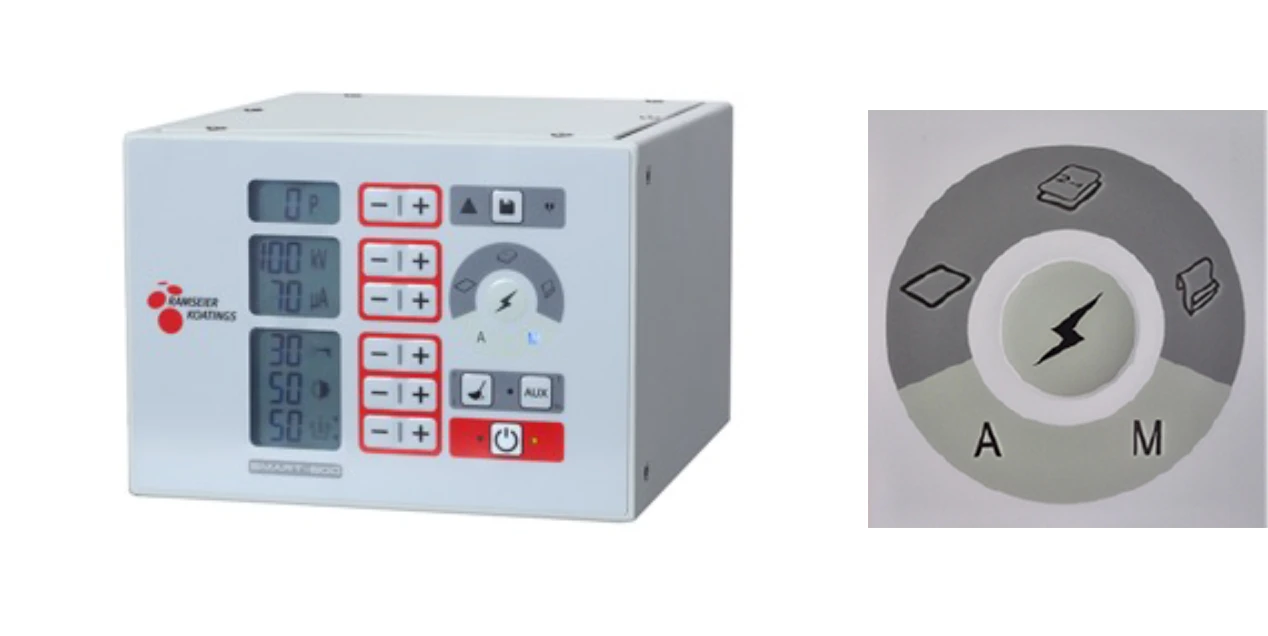
Mode A: Automatic Mode
Through countless experimental studies, we have developed a "total energy electrostatic powder charge control model" that fully automatically adjusts the discharge voltage and current to achieve the best surface coating and groove spraying penetration effect. This can greatly simplify the difficulty of manual adjustment during the spraying process. Without too many Settings, this control mode can automatically adapt to different spraying scenarios and objects to be sprayed. It easily enables powder to enter grooves, dead corners, welding areas and other difficult-to-spray positions, and can adapt to different types of powder and different metal materials of workpieces, greatly improving the efficiency of spraying production and the qualification rate of product spraying surfaces.
Yudong (Ruisai Gaotingshi) Technology Research and Development Department